

Campagnolo: The Italian Components Brand That Shaped Road Cycling
From the first quick-release hub to the iconic Nuovo Record and Super Record groups — the story of how one brand defined the language of performance cycling for over five decades.
✦ Precision Engineering · Racing Pedigree · Timeless Italian Design ✦
Few names in cycling carry the same prestige as Campagnolo. Founded in Vicenza, the brand became one of the purest expressions of Italian mechanical excellence, helping define the racing bicycle from the 1930s through the early 1980s. Its history is deeply tied to the golden age of steel road bikes, when Italian craftsmanship, racing culture, and technical innovation came together in extraordinary ways.
From the first quick-release hub to the iconic Nuovo Record and Super Record groups, Campagnolo did far more than manufacture parts. It helped shape the very language of performance cycling.
✦ Campagnolo did not just build components that worked; it built components that felt special to use, maintain, and admire. A philosophy of beauty and effectiveness that became the brand’s signature. ✦
Origins in the 1930s
Campagnolo’s story begins with Tullio Campagnolo, a racer with a practical mind and a talent for engineering. The brand’s founding legend centers on his frustration during a cold mountain race, when removing a wheel quickly proved difficult with the traditional wing-nut system.
That experience inspired the development of the quick-release mechanism, one of the most important inventions in bicycle history. In the early 1930s, Tullio transformed that idea into a commercial product, and in 1933 Campagnolo was established as a company. From the beginning, the brand stood for one central principle: solve real problems for real riders through elegant engineering.
| Year | Milestone | Significance |
|---|---|---|
| 1930 | Quick-release patent era | Marks the beginning of Campagnolo’s most influential innovation |
| 1933 | Company founded | Establishes Campagnolo as a real manufacturing brand |
| 1940 | Early gear-shifting systems | Expands the company beyond hubs into drivetrain technology |
From Hubs to Shifting Systems
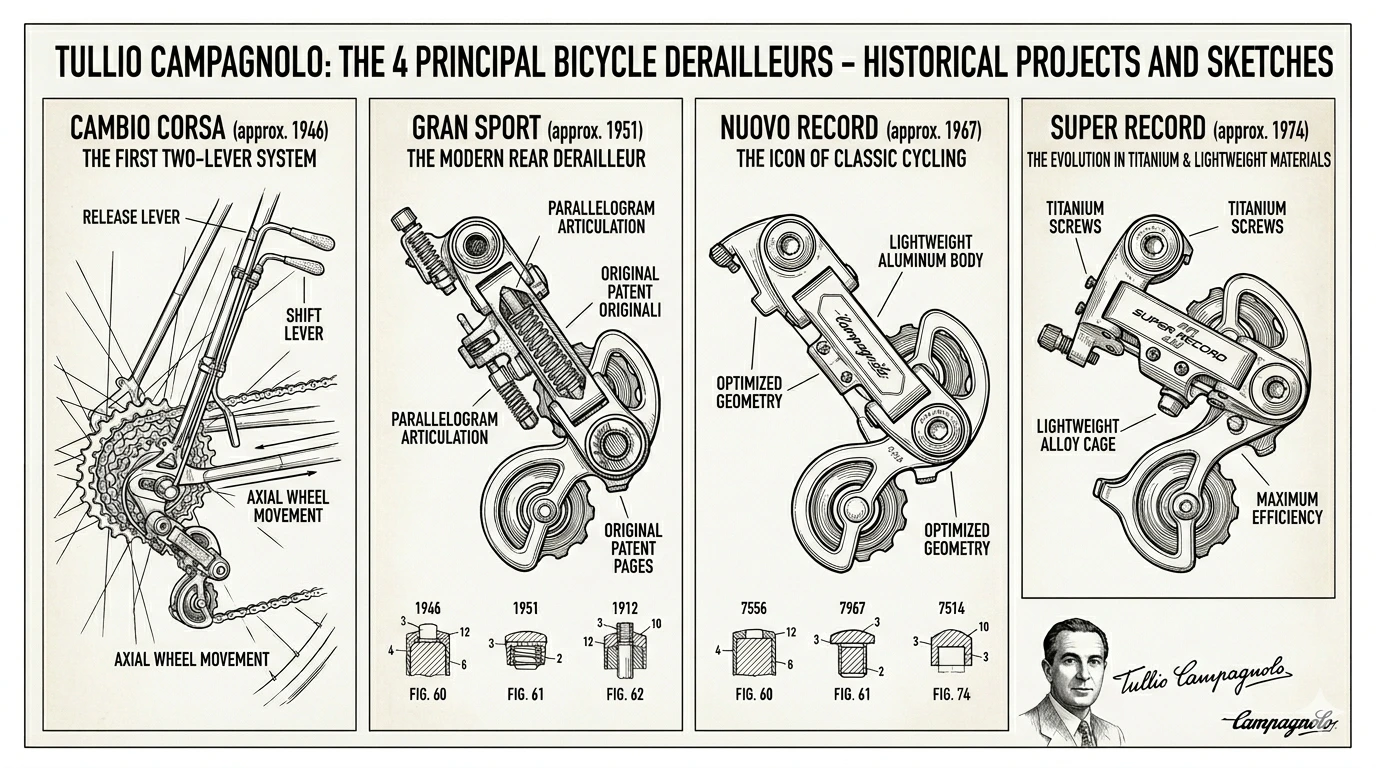
Campagnolo first built its reputation through hub technology, but it soon expanded into gear-changing systems. In the 1940s, the company introduced early derailleur mechanisms that marked a major leap forward from the older and more awkward methods used by cyclists at the time.
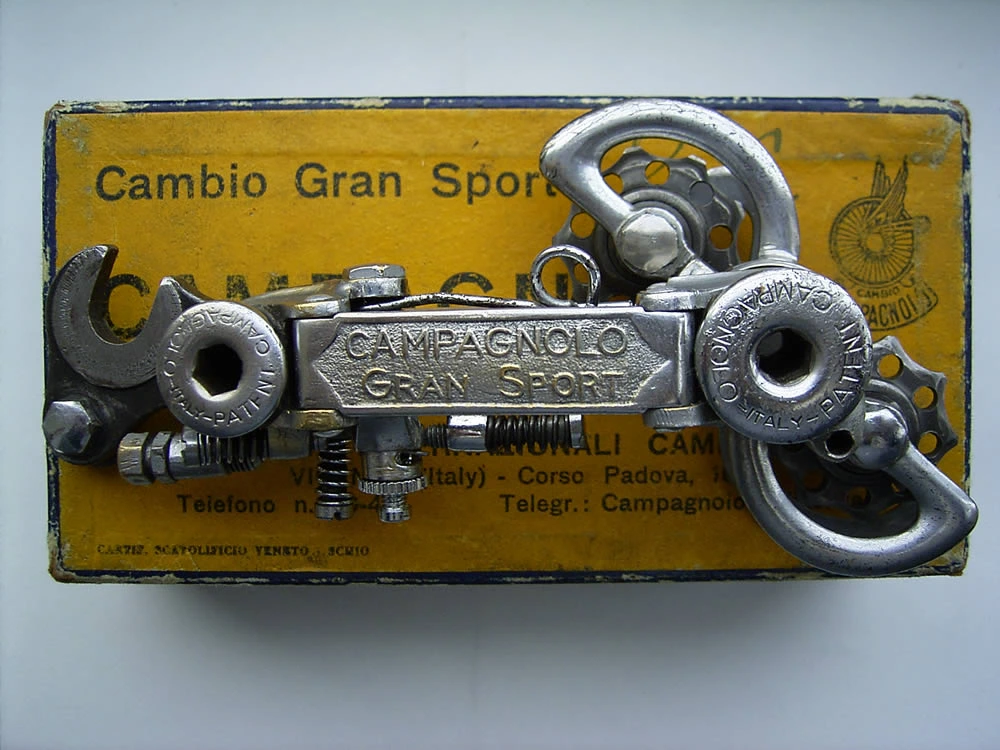
The decisive turning point came in 1950 with the Gran Sport rear derailleur. This model introduced a refined parallelogram design that would become the basis of modern rear shifting systems. It was a breakthrough in function and reliability, and it established Campagnolo as a leader in cycling technology.
The Gran Sport was not merely successful because it worked well. It also brought mechanical elegance to a part of the bicycle that had previously been more utilitarian than refined. That combination of beauty and effectiveness would become a Campagnolo signature.
The Rise of the Complete Groupset
One of Campagnolo’s greatest strengths was its ability to think in systems rather than isolated parts. During the 1950s, the company expanded beyond derailleurs and hubs to produce seatposts, cranksets, pedals, headsets, brakes, and other key components.
This evolution helped create the concept of the complete groupset: a coordinated set of parts designed to function together and to present a unified technical and aesthetic identity. This was a major cultural shift in high-end cycling. Instead of mixing components from different brands, riders and builders could now imagine a bicycle equipped entirely with one coherent system.
That idea proved incredibly powerful. Over time, a fully Campagnolo-equipped bicycle became a symbol of quality, seriousness, and prestige.
Campagnolo and the Golden Age of Italian Steel Bikes
Campagnolo’s most celebrated years coincided with the golden age of Italian steel road bikes in the 1960s and 1970s. This was the period when handcrafted frames from Italy reached a remarkable level of refinement, with thin steel tubing, elegant lugs, responsive geometry, and custom-built proportions.
Campagnolo components were the ideal match for these frames. Their polished finish, precise operation, and racing credibility complemented the beauty of Italian steel construction perfectly. Together, frame and groupset created one of the most admired combinations in cycling history.
The professional peloton reinforced this image. As more top riders and teams adopted Campagnolo, the brand became inseparable from elite road cycling. For many enthusiasts, the classic image of a golden-era race bike is still a steel Italian frame fitted with Campagnolo parts.
Nuovo Record and the Maturity of the Brand
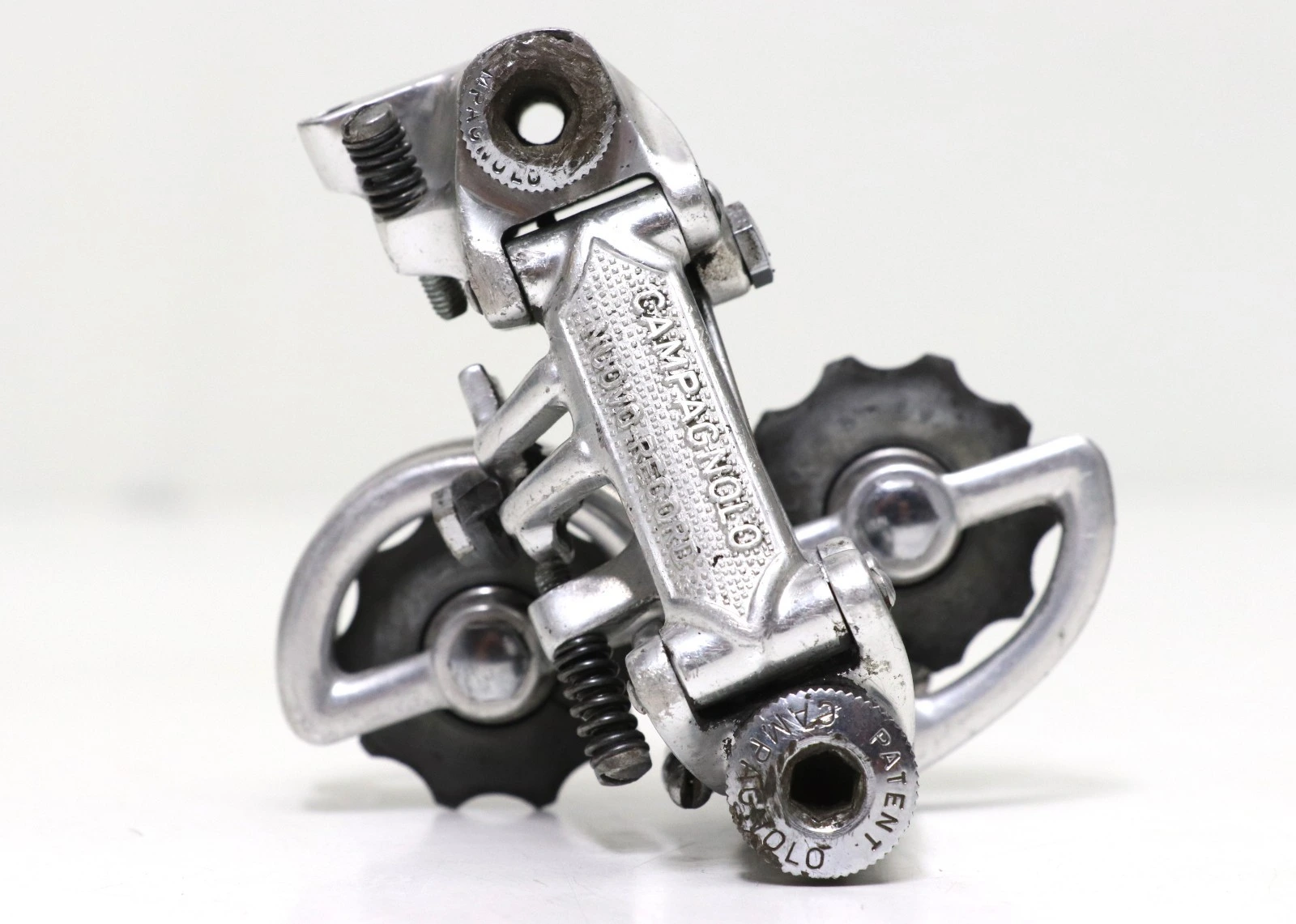
In the later 1960s, Campagnolo introduced one of its most iconic products: the Nuovo Record. This groupset represented the mature expression of the brand’s philosophy. It was lighter, more refined, and more race-oriented than what had come before, while preserving the elegance and reliability that defined Campagnolo’s identity.
The Nuovo Record rear derailleur became especially famous. Its shape, finish, and function made it one of the most admired mechanical components ever produced for a bicycle. For many cyclists, it remains the definitive classic derailleur.
The success of Nuovo Record was not only technical. It also marked the moment when Campagnolo fully became a cultural object. Its components were no longer just tools for racing; they were expressions of taste, status, and mechanical purity.
Super Record and the Peak of the 1970s
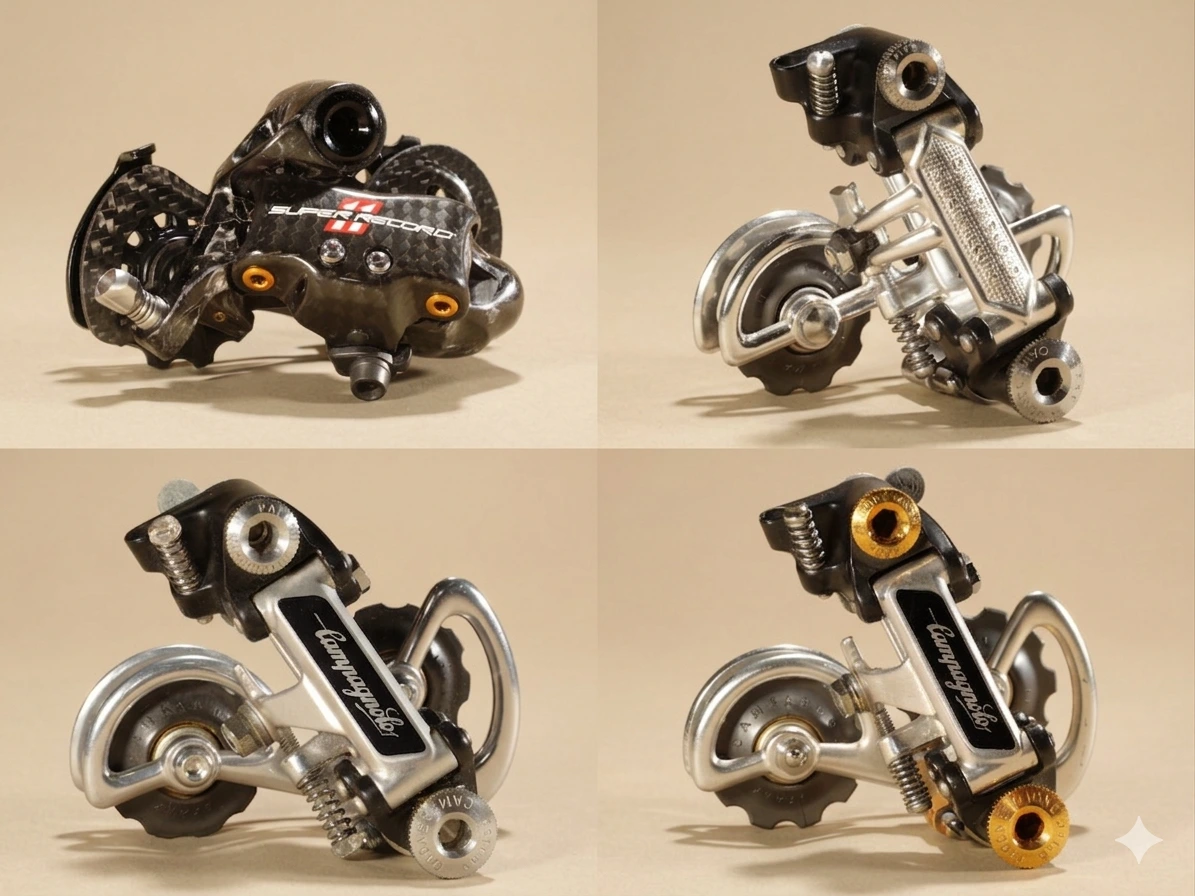
In the 1970s, Campagnolo reached the summit of its classic era with the introduction of Super Record. For many collectors and vintage enthusiasts, this remains the high point of the brand’s mechanical development.
Super Record took the Record concept and refined it further with lighter materials, more advanced finishes, and performance details aimed squarely at top-level racing. Some parts used titanium hardware, and the overall impression was one of extreme sophistication without abandoning the traditional logic of mechanical simplicity.
This was the Campagnolo of legend: elegant, light, race-proven, and unmistakably Italian. In an era before electronics and integrated control systems, Super Record represented the finest expression of what precision mechanical cycling equipment could be.
Technical Features That Made Campagnolo Famous
Campagnolo built its reputation on several enduring technical qualities:
- Precise shifting, thanks to the evolution of the parallelogram derailleur.
- Excellent materials, especially polished alloys and lightweight hardware.
- Mechanical reliability under racing conditions.
- Cohesive design across the full groupset.
- Strong visual identity, with parts that looked as refined as they performed.
These features made Campagnolo stand apart from many competitors. The company did not just build components that worked; it built components that felt special to use, maintain, and admire.
Collector’s Insight: The value of a vintage Campagnolo component or groupset depends on originality, completeness, condition, and period correctness. A complete groupset in clean, matching condition is particularly attractive, especially when paired with a high-quality Italian steel frame from the same era.
Why Collectors Still Love Campagnolo
Campagnolo holds a special place in the vintage market because it combines technical history, racing prestige, and visual beauty. For collectors, models such as Nuovo Record and Super Record are especially desirable because they capture the best of the steel-bike era.
Collectors also appreciate the detail. Logos, engraving styles, finishes, bolt materials, and subtle production differences can all influence desirability. This gives Campagnolo a depth that appeals not only to casual enthusiasts, but also to serious historians and restorers.
Campagnolo Timeline: 1930–1980
Transition into the Early 1980s
By the early 1980s, the cycling world was beginning to change. New competitors, evolving drivetrain concepts, and broader industrial shifts were reshaping the component market. Campagnolo remained a prestigious and influential brand, but the environment was becoming more competitive and technologically demanding.
Even so, by that stage the company had already secured its place in history. From the 1930s to the early 1980s, Campagnolo had helped define how a racing bicycle should function, how it should look, and how it should feel.
✦ From the quick-release to Super Record, Campagnolo didn’t just make components — it created the mechanical soul of the golden age of cycling. An enduring legacy of precision, beauty, and Italian excellence. ✦
Own a Piece of Campagnolo History
Explore our curated collection of vintage Italian bicycles, many equipped with the legendary Campagnolo components that defined an era of cycling excellence.
VISIT THE COLLECTIONSince 2024, Ciclileggenda preserves and celebrates the legacy of Italian cycling heritage. Every bicycle in our collection is verified for authenticity, provenance, and mechanical integrity — often featuring the Campagnolo components that made history.